
Mission: To foster enjoyment, appreciation, and understanding of the history of Cajun music!
"As is always the case, the art of a vital people speaks eloquently for those who create and recreate it." --Ralph Rinzler
Established May 26, 2002. Latest update July 1, 2022.
Neal Pomea (Pommier)
npomea@gmail.com
610 Eldrid Drive
Colesville, Maryland
20904
301-908-8429
Home Page and more information about the purpose here, copyright permissions, etc.
Various Artists: 1920s-30s , 1940s-50s, 1950s-60s
Historic Music: Nathan Abshire, Ambrose Thibodeaux, Lawrence Walker, Balfa Brothers, Octa Clark & Hector Duhon, Austin Pitre & Melton Molitor , Aldus Roger & the Lafayette Playboys, Denus McGee & Sady Courville , Mamou Hour Cajun Band , Joe Falcon & Cleoma Breaux, Amedie Breaux, Angelas LeJeune, Moise Robin, Revon Reed's Mamou Social (Supper?) Club, Clement Brothers
Recent Music: Ray Abshire , Cory McCauley, David Greely Tribute to Varise Conner , Robert Jardell, Jesse Lege, Chris Miller, Ganey Arsement
Special! Jack Leger & the Cajun All Stars
Jack Leger and the Cajun All Stars, Lanor 45s, circa 1975. He sometimes played accordion for the KEUN Mamou Hour Cajun Band led by Sady Courville when Revon Reed was the host from Fred Tate's. Danced to his exciting band at Coz's Blue Goose hall in Eunice around that time, early 80s. Here he is playing like a boss! Thanks to Bryan Lafleur and Jack Bond! Playing frottoir and singing with Ambrose Thibodeaux on accordion, live 1977 from Fred's Lounge in Mamou, Les Haricots Sont Pas Sales.
Special! Poor Hobo
1920s-30s
Description: 78s recorded from the collections of Joe Bussard, Ron
Brown, and others...; Early American Cajun Music, Yazoo cd 2042
The 1920s and 30s were a period of unequalled recording of the musical heritage of our country! The phonograph was finding its way into many homes, and people wanted to hear local music. With nothing more than the scant, vague promise that a furniture store, for example, could sell a few hundred copies of a local musician's songs, recording companies like Victor, Vocalion, Brunswick, Columbia, Bluebird, and Paramount sent engineers and recording equipment to outposts like New Orleans, San Antonio, Memphis, and Atlanta, or a bus ticket north to headquarters in Camden, New Jersey, Chicago, Richmond, Indiana, Grafton, Wisconsin, etc., and Cajun musicians were among the bunch to record alongside commercial artists like Jimmie Rodgers, jazz greats like Johnny Dodds, ragtime guitarists like Blind Blake, ladies of the blues like Bessie Smith, etc. And the Library of Congress had a mandate to go everywhere and record the story of the music people made when it looked to some like the world was going to end in the Great Depression, dust storms at home, and a world war brewing abroad! It was in that kind of setting that the recordings above were made, and they constitute a windfall. A fortunate, unique record of cultural history, with songs of joy and pride and common woes. A time of great music whose influence we cannot forget. Alright already, back to the roots!
Included: Wayne Perry's astonishing fiddle! Segura Brothers tearing it up on accordion and vocal, from a December 16, 1928 session in New Orleans! Haunting, uncommonly tender folk music from fiddler Delma Lachney, vocalist Blind Uncle Gaspard, and accordion player John Bertrand.
Douglas Bellard, a black fiddler, was the playing partner of the great Amede Ardoin before Ardoin decided to go with fiddler Dennis McGee, a white man who could offer him more protection when playing before crowds in those racially segregated days. Rumors and myths abound...Here Douglas is accompanied by Kirby Riley, accordion. These songs by Bellard and Riley are extremely rare! They are the basis of songs done by people like Austin Pitre, Bois Sec and Canray, Iry Lejeune, and others.
See Recording Activity in New Orleans in the 'Twenties for an interesting rundown of the diversity captured at just one of the outposts recording music at that time.
Lomax made a field trip to southwest Louisiana in 1934, where he recorded Wayne Perry. He also recorded Edier Segura's playful tune, Joe Feraille, sung with a fiddle accompaniment, c'est tout! It seems petit Joe Feraille is a hustler who trades his wife for a barrel of pecans, only to have her return to him soon after the bargain for a repeat con on another poor soul. He trades her again for corn, peanuts next time, and so on. C'est ca il a dit dans la chanson!
Oscar "Slim" Doucet, the accordion player, does two songs here with a man named Chester Hawkins on guitar: Waxia (Wauksha) Special (reprised in splendid fashion by Les Freres Michot on their new CD La Roue qui Pend!); and Chere Yeux Noirs, not to be confused with 'Tit Yeux Noirs by Lawrence Walker. Guidry Brothers do La Valse du Mariage (also reprised by Les Freres Michot!).
Leroy "Happy Fats" LeBlanc of the Rayne community led a little string band called the Rayne Bo Ramblers through Les Filles de St. Martin, an early version of the popular Choupique Two Step associated with Nathan Abshire.
Columbus "Boy" Fruge from Arnaudville was a contemporary and friend of Moise Robin. He recorded four songs: the famous Saute Crapaud (Jump Toad), not included here due to sound quality, and the three included here. The Point Claire Blues turns out to be an early version of a song I had previously associated with Nathan Abshire, The Lemonade Song.
One step, not two, by the great, great Amede Ardoin, a black accordion player regarded as one of the fathers of the Creole music style, the roots of Zydeco! What intensity!
Cleoma Falcon with her brother Clifford Breaux are heard on a couple of "American" tunes, J'Suis Partis sur le Grand Chemin Tres Disatisfe (Going Down the Road Feeling Bad), and Continuez Sonner (Keep Knocking but You Can't Come In)! It just goes to show how Cajun music in the 20s and 30s was a real melting pot of styles and influences. For such an isolated group as the Cajuns, their musicians sure were tuned in to the popular music of the day. Clifford sings jazz-like scat on Continuez Sonner! But you could still hear really old sounds dating far back even while these modern influences were at work. And when Cajun musicians took from the popular culture of the day, you could be sure they'd put their own stamp on it and give it a unique twist, making it their own.
By the mid- to late 1930s a new wave made its way into Cajun music with a string band sound influenced by country and Western Swing music coming in from the influx of Texans, etc. coming to Louisiana for its first big oil boom! Early adopters represented here include Dudley and James Fawvor, J.B. Fuselier (Miller's Merrymakers), and Leo Soileau.
The lovely Creole Waltz done by the Fawvors has the lyrics associated later with Tout Les Deux Pour la Meme (Both for the Same) by Lawrence Walker. You can hear a great version of this tune on the Varise Conner cd mentioned up above. You are Little and You are Cute is of course the well-loved T'es Petite et T'es Mignonne.
J.B. Fuselier contributed some of the standards of the Cajun music repertoire. He was the first to record Chere Tout Toute under that title, though Angelas LeJeune also uses the tune in one of his recordings. He was the first to record the Lake Arthur Stomp under that title. Authorship of the Lake Arthur Stomp is ascribed to the remarkable fiddler Varise Conner, whose music is featured in a tribute earlier on this Web site. Parts of the tune also appear in the recordings of Dennis McGee. Fusilier moved to Lake Arthur so that he could play with Varise Conner, and they played dances during some of the leanest days of the Depression. J.B. played both fiddle and accordion. On a side note, it was J.B. Fuselier accompanying Iry LeJeune home from a dance when the two had a flat tire and pulled off the road to fix it. A passing car struck and killed Iry and put J.B. in the hospital! Varise Conner remembers his friendship with Fuselier in a touching interview on the Louisiana Folk Masters cd. Also, Miller' s Merrymakers were led by a guitarist named Beethoven Miller and another guitarist named Preston Manuel. Manuel is featured on this Web site with the KEUN Mamou Hour Cajun Band and also appears with Ambrose Thibodeaux. Small world!
The great fiddler Leo Soileau along with Maius (Mayeus?) Lafleur, later Moise Robin, on accordion is thought to be the second Cajun musician to record. Those recordings are legendary! Here we feature some of his later recordings with his string bands the Rhythm Boys and the Four Aces. Frankie and Johnny, popularized by Jimmie Rodgers, gets an instrumental treatment with a lot of attitude! Hear the shouts of his band members telling him to "make it hot, Leo!" Louisiana Blues and La Bonne Valse epitomize Soileau's soulful, mournful sound. Then Bing Crosby's Little Dutch Mill and the sentimental Beautiful Mary show how pop tunes wove their way into the music. Soileau retired from music in the 1940s with the demise of the string band sound.
The Hackberry Ramblers were formed in the string band environment of the 1930s by Luderin Darbonne on fiddle and Edwin Duhon on guitar and various instruments, and an amazing vocalist named Lennis Sonnier. They were the first to record the song Jolie Blonde under that title, and they had an a remarkable run of popularity. They were the first Cajun band to play the bandstand standing up, first to use amplification in their dances. They ran their Model T Ford battery during the dance with cable into the hall to electrify the fais do-do!
Pic of Wayne Perry, Indian Bayou, LA, recorded by John Lomax for Library of Congress. Look how he holds his bow! Is he into it? (Source: LOC American Memory)

Recommended: We are very fortunate today to have so much music from the 1920s and 1930s available on CD, much more than was available even when this Web site began in 2002.
Ever since the 1970s I was aware of recorded Cajun and Creole music from the 1920s and 30s through an outstanding series of lps (long-playing records) on the market by the Arhoolie Records label. I will always be grateful to producer Chris Strachwitz for making that music available! It's as if it's in my DNA now! Some of these remarkable lps are still available from the Arhoolie Web site, with these titles: Louisiana Cajun Music Volume 1, First Recordings (OT108); Louisiana Cajun Music Volume 2, The Early 30s (OT109); Louisiana Cajun Music Volume 3, The String Bands of the 1930s (OT110); Louisiana Cajun Music Volume 4, The 30s to the 50s (OT111); Louisiana Cajun Music Volume 5, 1928-1938 (OT114); Amade Ardoin, His Original Recordings 1928-1934 Volume 6 (OT124); Leo Soileau, Louisiana Cajun Music Volume 7 (OT125).
From 2004-2008, the JSP label put out three 4-CD sets that cover a good portion of the 1920s and 30s recordings. Look for Cajun Early Recordings (JSP7726), Cajun Country 2 (JSP7749), and Cajun Music Rare and Authentic (JSP77115). Also look for recordings by Dennis McGee and Leo Soileau, who have individual compilations available on the Yazoo label. Unforgettable!
Recently, in 2011, Tompkins Square released an essential compilation of Amd Ardoin recordings with much improved sound mastering by Chris King! It's just great to have all 34 of these great recordings available in a single 2-CD set! Look for Mama, I'll Be Long Gone: The Complete Recordings of Amede Ardoin 1929-1934! This music by the great black Creole singer and accordionist Amd Ardoin, first with fiddler Dennis McGee and then solo, includes some of the most important and influential, not to mention beautiful, tunes and lyrics in all of Cajun and Creole history. Many of his songs became standards or well known songs in the Cajun and Creole canon, sometimes with different names, as shown here.
1940s-50s
Description: Early local recordings after World War II, from regional
labels like Feature, Fais Do-Do, Folkstar, Opera, etc. Special thanks
to Lyle Ferbrache of Brentwood, California for his generous contributions to preserving and
documenting this little known era of Cajun music! More essay to come.
The great Harry Choates is surely in everyone's Cajun Music Hall of Fame. He made an important contribution to local pride with his wildly popular version of the crossover hit, Jolie Blon, to the point that some people still call it the Cajun national anthem! A short but brilliant life, some would say wasted, he was a casualty in his twenties of a raucous, honky tonk life style, but boy was he fun when he was on! His signature cry Eh Ha Ha! epitomized the music of the 1940s and early 50s at its most joyous. Hear Oh Mignonne, a swing reworking of Leo Soileau and Mayeuse Lafleur's Ton Papa M'a Jete Dehors from the 20s! You might think the fiddling on C'est Pas La Peine (What's the Use?) sounds suspiciously like Nashville, but no, it's the other way around! He and fiddlers like Chuck Guillory and Rufus Thibodeaux influenced the Nashville sound immensely. Brilliant!
Valse de Hadacol is one of our theme songs around here. The lyrics are in the form of a testimonial from a satisfied customer thanking Nonc Dudley, i.e. Dudley J. LeBlanc, the maker of this "miracle" tonic.
Mon petit garcon a plus des crises
Ma vieille a plus des rhumatismes
Sont plus malades at all at all
Depuis ils ont pris le Hadacol
Sois garanti, tu prends quelques doses
Tes yeux sont claires, tes joues sont roses
Prends quelques bouteilles et je te promets
Tu vas jongler pour courtiser
Jai fait serment dessus la Bible
Me sentir mieux. Cest pas possible!
Moi qui te dis je peux remercier
Le Hadacol a Nonc Dudley
Si tas des douleurs mais tout partout
Dans tes jambes et dans ton cou
Si tas besoin des vitamins
Le Hadacol peut le mettre within
Si les docteurs tont decomptes
Y a une sauce pour tas casse
Y a une chance pour ta sante
Le Hadacol peut te le donner
Viens faire serment dessus la Bible
Te sentir mieux. Cest pas possible!
Moi qui dis qui a remercie
Le Hadacol a Nonc Dudley
"Pendant longtemps jai misere
Sus juste du lait et du pain grille
Asteur c'est bien, je me bourre des huitres,"
Say Nonc Ignace a L'Anse la Butte
"Jai pris le tonique a Nonc Dudley
C'est aa ca pris pour mengraisser
Asteur ma vieille me trouve si mieux
Elle me prend pareil quun amoureux."
Jai fait serment dessus la Bible
Me sentir mieux. Cest pas possible!
Moi qui dis je peux remercier
Le Hadacol a Nonc Dudley!
transcription by Christian Landry, Daniel Blanchard, and Neal Pomea
Lee Sonnier of Crowley was the first Cajun to record with the accordion following World War II. He was recorded by J.D. Miller in 1946. The "post-War" accordion sound really took off with the Houston-based Opera label release of Iry LeJeune with the Oklahoma Tornadoes, Love Bridge Waltz. If anybody has information on the name of this tune please contact me by e-mail. From there on a slew of accordion players recorded, including Austin Pitre, Nathan Abshire, Lawrence Walker, Lionel Cormier, etc., and a boom was on for dancehall music. The rest, they say, is history!
Recommended: Arhoolie cd 427, Cajun Honky Tonk, includes great 78s recorded in the late 40s/early 50s for the Khoury label of Lake Charles and other regional record labels. Included: Nathan Abshire, Lawrence Walker, Harry Choates, Floyd LeBlanc, the Musical Four Plus One, Elise Deshotels and his Louisiana Rhythmaires (featuring vocals by Dewey Balfa and accordion by Maurice Barzas!), Shuk Richard with vocals by Marie Falcon, etc. Maurice Barzas and the Mamou Playboys was one of the earliest bands featuring the accordion after World War II. Their long lasting gig at Snooks' Lounge in Ville Platte (something like every Saturday night for 35 years!) featured Two Step de Ville Platte as theme song. You can get two CDs of the wonderful music of Maurice Barzas and the Mamou Playboys through Tina Pilione of the Savoy Music Center in Eunice, Louisiana. The live tape recordings that form the basis of these CDs were made in the 1970s and 1980s, but the music and atmosphere captured in the recordings certainly well represent the post-World War II milieu. For ordering information see http://www.tinapilione.com/. Also, Bear Family Records has a landmark collection of the music of Harry Choates entitled Devil in the Bayou: The Gold Star Recordings. Reissue producers Andrew Brown and Dave Sax have given us our fullest picture yet of the life and times of this unforgettable musician. We owe them our sincere thanks!!
1950s-60s
Description: Proud jukebox standards of the 1950s and 1960s with various artists. Love the way Sidney Brown ended his recordings with Bingo! Domino!
My daddy told me that a long time ago. To him, there never was a time when things progressed so much as in the 1950s, the 60s. Pense, donc! Merci Bon Dieu! Electricity in the house and some kitchen appliances you never had before! The parish paved the road. To go to school you could take the school bus, the transfer, not a horse and wagon anymore. You could haul the rice to the mill in Kaplan, Rayne, or Crowley and get a good price. No easy street or gravy train, just better than Depression days and lonesome years in the War. Lots of "Cadiens" in southwest Louisiana felt that way! I did. The music told a story. It was proud, it was new, it laughed at us how we were in the old days, all at the same time. Natural, a renaissance to be proud again of being French in America!
Description: Rare Private Recordings! Nathan Abshire plays accordion and sings the old Joe Falcon song, A Cowboy Rider, as well as Tramp Dessus la Rue. Guitarist Preston Manuel sings Bayou Chne. Sady Courville plays fiddle, introduces Tramp Dessus la Rue, and pitches the Mothers Day specials of the Mamou merchants. What a voice! The man in charge is Revon Reed, from the floor of Fred Tate's Lounge for the KEUN Mamou Cajun Hour, a live broadcast which aired from 9-11 AM on Saturdays, station 1490. Sounds to me the way I used to hear them in the mid to late 1970s! This goes out with many thanks to the Reed family.
Be sure to hunt for Cajun music on YouTube! You might find this rare video of Nathan playing with Sady and Pres on his signature song, Ma Negresse (Pine Grove Blues). Don't miss 5:25 on! "The natives are getting restless!"
| Le Cowboy Rider | Tramp Dessus la Rue |
| Bayou Chene |
Recommended: Arhoolie cd 373, French Blues, documents Nathan's early 1950s recordings for the Khoury label from Lake Charles. For late 50s, early 60s, Nathan recorded with J.D. Miller from Crowley and his music was re-released on Flyright CD 19, Nathan Abshire and the Pinegrove Boys. Swallow Records from Ville Platte put out recordings from the 1960s and 70s on CD 6061, The Best of Nathan Abshire. La Louisianne Records from Lafayette leased its 2 lps of Nathan's recordings from the 1970s to Ace Records of Great Britain, available as Nathan Abshire: The Great Cajun Accordionist . Good luck finding those! Great compilations featuring Nathan include Arhooolie CD 416, Cajun Fais Do-Do, and Les Haricots Sont Pas Sales on Cinq Planetes from France.
Description: The Authentic Sounds of Cajun French Music and Folk Songs of Acadiana, out of print and hard to find lp Bee-136, produced by Elton "Bee" Cormier
accordion: Ambrose Thibodeaux; fiddle: Leon Doucet, Ken David; guitar: Reggie Matte (vocal on Eunice Waltz), Gervais Quibodeaux (vocal on Jolie Fille), Robert Sonnier, Mark Latiolais; triangle: Elmer Thibodeaux, Joe Bradford
Respectfully known as "Uncle" Ambrose, this musician was a fixture on KLFY TV Channel 10 from Lafayette, Louisiana in the 1960s and 70s on the early morning show Passe Partout, right after the French rosary to start off the day. He certainly played the older songs in a tempo with dancers in mind. Simple and beautiful! In his live performances he would signal the approaching end of a tune with characteristic good humor, hitting the wrong chord and putting an abrupt stop to things. We owe a lot to Ambrose Thibodeaux for keeping some old, forgotten songs alive and for composing his own in the older style. He was a mainstay on Revon Reed and Sady Courville's Mamou Cajun Hour radio broadcasts Saturday mornings on KEUN 1490 AM direct from Fred's Lounge in Mamou, playing triangle and accordion and also participating as a fine dancer. Known for his easy, solid sense of time on his two steps, he had a fine sense of drama as well, building tension! No step skipped! What's the rush? Douement!
These selections are dedicated to Pete Bergeron. Pic I took at the 1977 Festivals Acadiens in Lafayette, Louisiana, with Bessyl Duhon on fiddle, Bee Cormier on guitar, and Leola Thibodeaux on triangle.
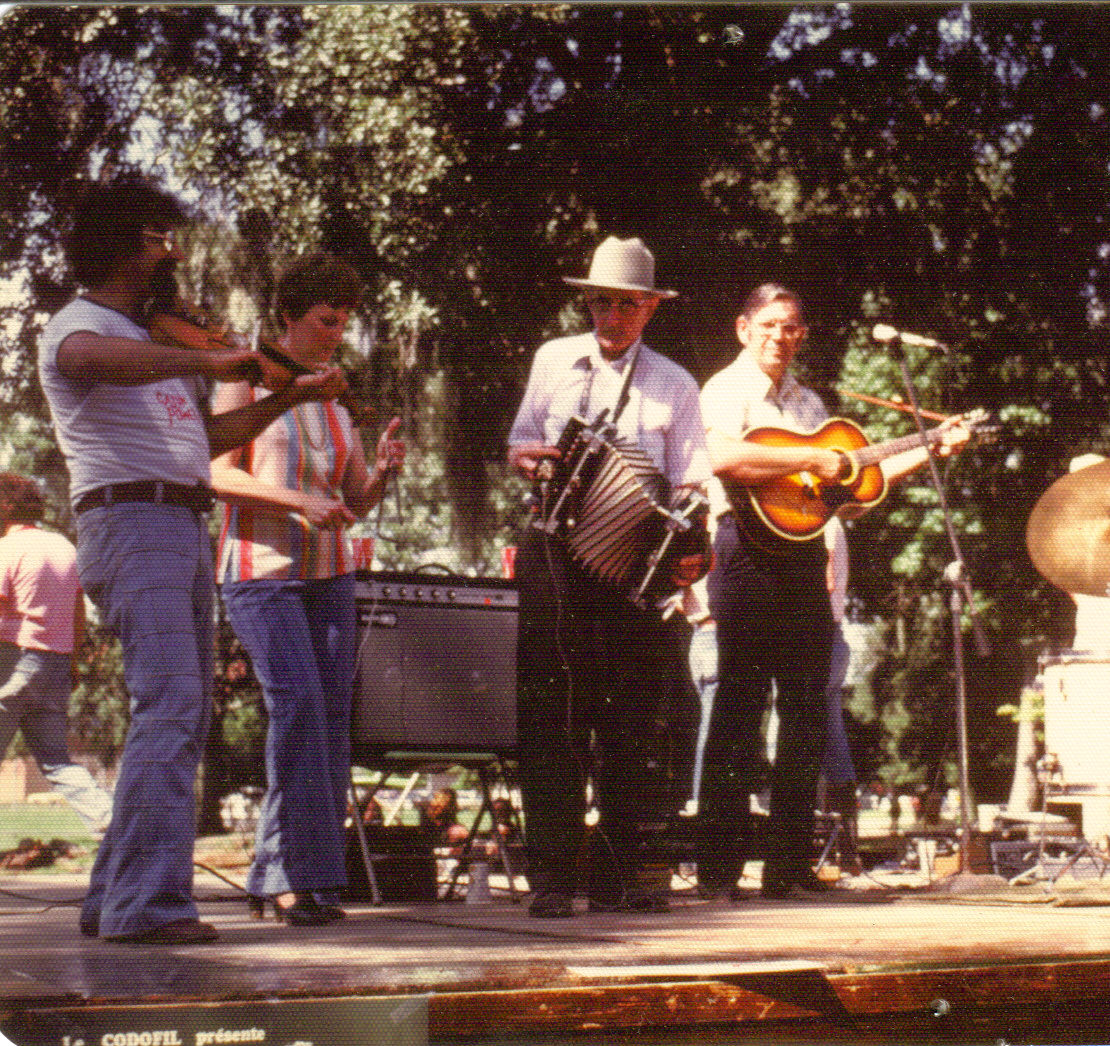
Recommended: La Louisianne Records in Lafayette, Louisiana may still have a few copies of the four lps that Uncle Ambrose recorded for their label. They are all landmark Cajun albums, so get them all if you can! Don't be dismayed by their confounding, similar titles: 1. Authentic French Acadian Music, 2. More Authentic Acadian French Music, 3. That French Acadian Sound, and 4. Authentic Cajun French Music and Folk Songs. Mais monde!
| Le 'tit Negre a Tante Dolie | Eunice Waltz |
| Church Point Two Step | Jolie Fille |
| Lafayette Two Step | Elton Waltz |
| Grand Mamou | How Come |
| Dear Alice | Ridge Road Waltz |
Lawrence Walker
Description: Live dancehall recordings from the 1960s that appeared on the long out of print and rare Flyright lp 3502, Jambalaya on the Bayou Volume 1. Special thanks to Dave Sax for making this available!
accordion and vocals: Lawrence Walker; fiddle: Lionel Leleux; with steel guitar, rhythm guitar, and drums
Lawrence Walker has been described by Barry Ancelet as too late to count as one of the original Cajun musicians recording in the 1920s and 30s, although he did indeed record that long ago, and yet too early to participate in the renaissance of Cajun music that occurred in the 1960s and beyond. He was certainly one of the most respected and influential Cajun music recording artists and dancehall performers immediately following World War II and into the 1960s. He set a high standard for musicianship and emotional vocals along with showmanship with his accordion. Some of the songs he recorded remain among the most beloved Cajun songs of all time, including Chre Alice, Reno Waltz, Mamou Two Step, Unlucky Waltz, Bosco Stomp, Both for the Same, and so on!
Recommended: Swallow cd Essential Collection of Lawrence Walker, SW 6221, was released in 2010. Includes his 1961 material for the La Louisianne label, some of his very best recordings like Unlucky Waltz, Chre Alice, Reno Waltz, and Allons Rock and Roll. Arhoolie cd 427, Cajun Honky Tonk, includes some of Walker's early sides recorded in the late 40s/early 50s for the Khoury label of Lake Charles.
| Another Nail in My Coffin | Let's Do The Cajun Twist |
Balfa Brothers
J'ai Passer devant ta Porte
Le Hackberry Hop
Valse de Platin
Port Arthur Waltz
Valse de Reno
Madeleine
Un 'Tit Repeat de 'Cadien d'Church Point New!
Jolie Blonde
J'aimerais te Pardonner
Dewey Balfa fiddle demo: Pretty Little Christine, Rosina, Perrodin Two Step, Liberty/Saute Crapaud
Dewey Balfa and group at Wheatland Festival, Remus, Michigan: Fiddlesticks, Les Reves d'un Veuf e, Mon P'tit Mouchoir, Acadian Two Step
Octa Clark and Hector Duhon
accordion and vocals: Octa Clark; fiddle: Hector Duhon, Bessyl Duhon, David Greely, Rick Michot; guitar: Bessyl Duhon, Steve Riley
Octa Clark was one of the finest accordion players in Cajun music history. None finer, ever! He was a contemporary of Joe Falcon and Amedie Breaux and started off in the 1920s, but for personal reasons he turned down many offers to record over the years, so his name as a Cajun music pioneer is not as familiar as it should be. Still he was well known and influential locally in Louisiana. Together with fiddler Hector Duhon, his longtime musical partner and neighbor from Judice, Louisiana, he was re-enlisted to present the old-time music during the "Cajun Renaissance" period of the 1970s at many festivals in Louisiana and elsewhere, inspiring generations of young musicians!
Hector Duhon played his fiddle in unison with the accordion rather than taking leads, which is something of a forgotten fiddle style. His son Bessyl accompanied them on guitar when they were the first Cajun musicians to perform at the prestigious University of Chicago Folk Festival in 1972.
The Jamboree Waltz was an original composition by Clark as a theme song for a live radio program featuring him with Hector Duhon's Dixie Ramblers from Madame Webb's Neighborhood Club in Lafayette, Louisiana in the late 1950s. In 1993 Clark used the same arrangement of this song and updated the lyrics to coincide with the Breaux Bridge Crawfish Festival and released the selection as the Crawfish Waltz on CD.
Recommended: Old Time Cajun Music, Arhoolie CD 9018, the album length release by Clark and Duhon with Mike Doucet on rhythm guitar. Then there is the rare 1993 CD You Cant' Go Wrong if You Play it Right, c/o Glen Clark, Fieldspan, 606 Burlington Circle, Broussard, Louisiana, 70518, gclark@fieldspan.com. A majority of the songs posted here are original compositions and arrangements of Octa Clark and all publishing and copyrights are held by Fieldspan Music BMI, and are NOT in the public domain. Please contact Fieldspan for further uses, recording licenses and information on attributing them to Mr. Octa Clark. Special thanks to Fieldspan Music for permission to post them here!
Austin Pitre & Melton Molitor
Description: Cajun Folk Music, lp Prestige International 25015 (long out of print), recorded 1956-1959, with Pitre on accordion, vocals, fiddle; Molitor on accordion and vocals (family spelling of first name was Melton, NOT Milton!); and Lurlin LeJeune on guitar. Thanks to Jack Bond for making these rare recordings available. If this is not yet in the public domain, well, shouldn't it be? This is much too culturally important to the Cajun people to ever belong perpetually to some individual or publishing company. Classic pic by Harry Oster of this band of merrymakers! Love this picture!

Maxie Waltz sounds like a variant of Grand Bois! Ninety Nine Year Waltz is actually Molitor's version of Valse de Bambocheur, with Austin on fiddle, and probably my very favorite for the way Molitor's vocal slowly, slyly draws it out. Tout l'monde autour de moi aprs m'point aux doigts! Every night he goes to bed and falls out turning over, can't sleep. He's a vagabond, a good for nothing, a Louisiana French prodigal son, thinking of mom and pop and his own foolishness for ever having left home. Great stuff!
The lyrics here to Danse de Mardi Gras are interesting but should not be considered definitive. In fact, it is one of the strengths of this song that so many versions occur! I like this version a lot for its call to lend a hand to help the poor.
Madame, donnez, mais, la main -z- avec les pauvres, les Mardi Gras.
Et eux-autres, ca passe une fois par an pour l'avoir, la charite.
Donnez-moi quand mme, une 'tite poule jinga pour un gombo.
Madame, mettez la main z- avec les pauvres, les Mardi Gras.
Et eux-autres est gone dans tous les pres, 'pres essayer gagner leur vie.
Ca vient z- une fois par an, gaspille, faut s'oblige.
Madame, mettez la main avec les pauvres, les Mardi Gras.
Et eux-autres, ils ont la crve de faim, et a passe une fois par an.
Crier, c'est oblige, de donner pour -z- eux manger.
Les Mardi Gras prendraient de ta main, mais, une 'tite poule jinga.
Mais eux-autres, une fois tu y eux as arrange,
Parce qu'il sont si miserable.
Va donc, mettez la main z- avec les Mardi Gras. (Transcription by Daniel Blanchard and Neal Pomea)
Aldus Roger
& the Lafayette Playboys
Description: Has there ever been
a 5 piece Cajun band this good? Maybe. Heard 'em when a baby, heard 'em when
a man. Still smiling! KLFY TV Channel 10. Phillip Alleman on steel and vocals.
Man Abshire, drums. Popeye Broussard, Doc Guidry, or Louis Foreman, fiddle.
Charly lp GCL-110, re-release of Goldband Records material, 1989
Recommended: CD La Louisianne 1007 (great selections!)
| Diga Ding Ding Dong | Duson Waltz |
| Lafayette Playboys' Waltz | Hix Wagon Wheel Special |
Denus McGee
& Sady Courville
Description: Morning Star lp 16001 recording session, July 30, 1972 at the home of Joe Bussard,
Frederick, Maryland. Music and talk just as it happened! Comments by Denus
and Sady, Dick Spottswood, Joe Bussard, and the Morning Star folks, Rich Nevins
and Charlie Faurot.
Recommended: Jack Bond worked incredibly hard for several years to have the Morningstar lp 16001 released on CD. It was finally released on Field Recorders Collective 308 in 2007. Thanks so much, Jack, for your dedication and great love of Cajun music!
Bouquis
Manuel Breakdown
Crowley
Two Step
Tolam Waltz
Chere
Mom
Let's Call It Happy
Two Step
Lafayette
"Languages have dictionaries, Cajun music had Dennis McGee" -- Marc Savoy
Mamou Hour
Cajun Band
Description: lp This is Mamou
Cajun Radio, Sonet Stereo SNTF 802, 1979
announcers: Revon Reed and Sady Courville; accordion and vocals: Roy Fuselier;
fiddle: Sady Courville; guitar: Preston Manuel; triangle: Joe Bradford. "... programme Franais ici est amener a vous par les marchands qui fait la programme possible, icite a Grand Mamou, la place beaucoup connu comme 'Fred's Lounge,' Mamou Cajun Hour!" There
have been some good bands Saturday mornings chez Fred Tate, inside the roped
off area, but this is my favorite. Sady: "Ok Roy. Quoi on a pour eux autres?" Roy: "Everybody
on the floor! Tout l'monde sus l'plancher pour un bon temp!"
Lafayette
Chre Tou Toute
Tous les Soirs
Love Bridge Waltz
Le Cajun Strip
Hathaway Two Step
La Valse a Famille
'Tit Chemin Croche
Grand Mamou
La Pistauche a Tante Nana
Johnny Peut Pas Danser
Joe Falcon
& Cleoma Breaux
Description: Some rare
78s from the collections of Joe Bussard of Frederick, Maryland, and Lyle Ferbrache of Brentwook, California. Great
accordion, great singing from the husband and wife team of Joseph Falcon
and Cleoma Breaux of Rayne! These songs are from the late 20s, early
30s. They were some of the Cajun music sensations of those days, being
the first to record commercially. Waltz that Carried Me to My Grave
was side A, Lafayette (Allons a Lafayette) was side B. Joe was known
for how he could "turn" a song with the bridge or B part. And Cleoma
(sister of the fabled Breaux Brothers) may be Cajun music's best loved
female artist. Fee Fee Poncheaux? Non, mais ca scorch! Mon Vieux d'Autrefois (My
Old Used to Be), too!
Cajun music historian Ron Brown of Athens, Tennessee points out that the recordings Cleoma and Joe made for Decca records in New York, New Orleans, and San Antonio in 1934, 1936, and 1937 (and their recordings for Bluebird) are among the most cherished! They recorded under Cleoma's name, under Joe's name, and as the Falcon Trio, with fiddlers Ulysse Falcon on some sessions or Mose Morgan on others. It's possible that Cleoma's brothers Clifford or Ophy of the Breaux Brothers appeared on some of them, as well.
I'm struck by how Cleoma seemed to like to sing "American" songs from the old time country and blues repertoires, sometimes in English. There are two versions of the same song here, one in English and one in French, with Raise Your Window High and Ouvrez Grand ma Fenetre. Lulu's Back in Town is her French version of a popular song of the day. Careless Love, It's a Sin to Tell a Lie, I Don't Want Your Greenback Dollar, and Just Because get "Cajunized" here. See the 1920s-30s section for her version of Going Down the Road Feeling Bad, and hear her accompany her brothers on Continuez de Sonner (Keep a Knockin but You Can't Come In)! Another thing that strikes me is how Joe's melodies appear again and again in the standard Cajun music repertoire under different names! Ma Valse Prefer, for example, sounds like Grand Mamou; La Valse Crowley like the Lafayette Playboys Waltz; Frisco like Vermilion Two Step; Pin Solitaire like the B.O. Sparkle; Mon Favori Waltz like Valse de Grand Bois; Au Revoir Cherie like Evangeline Special; Le Nuit Samedi like the Valse de Samedi au Soir; Ne Buvez Plus Jamais like J'etais au Bal; Valse de Baldwin like Chere Alice; etc. Joe's name doesn't always pop up in lists of all time top Cajun accordionists, but I will say this. He's not flashy but he sure keeps good time! I really like the tension he builds in a song's bridge.
Please excuse the sound quality of some of these rare 78s.
Amedie Breaux
Description: Feature
78s 1023 and 1024, circa 1951. Hank Williams and Lefty Frizzell were kingpin in '51, but this could have left them crying in the dust! Scorch. I am telling you: this is some of the hottest music on this website!
| Jolie Blonde | Acadian Two Step |
| Criminal Waltz |
Angelas LeJeune New!
Description: Rare
78s of one of the most powerful Cajun French artists to record in 1929 and 1930! One of the best of the originals to record in the early days.
Ann Savoy's book, Cajun Music: A Reflection of a People, gives us Denus McGee's account of how Angelas LeJeune came to record. LeJeune, who was an older cousin of Iry LeJeune from the Point Noire area near Church Point and known to the community as Nonc Jack, won an accordion contest in Opelousas in 1929. First prize was a trip to New Orleans to record with legendary fiddlers Denus McGee and Ernest Fruge. September 20, 1929. 6 songs, 3 records in all for the Brunswick label, that are surely some of the most powerful music in Cajun history. One listen to the Vieille Valse de la Louisiane, especially the bridge or "turn," will show what a powerful player he was. Brilliant! And his Perrodin Two Step? Unsurpassed!
Angelas LeJeune was one of the most influential of the early Cajun accordion players. His repertoire passed down to his younger cousin Iry LeJeune, who made big hits with his reworkings of tunes by Angelas and Amede Ardoin in the late 1940s, early 1950s. His Valse de la Veuve (aka La Fille de la Veuve) is the same tune as Jolie Blonde but with a different story. It looks like in the 20s and 30s, the "standards" were still "under construction," with lots of songs having multiple titles and alternate lyrics. We get some of our standards from his recordings, including songs better known today under the titles Catch My Hat, Chere Tout Toute, Kaplan Waltz, Bayou Pon Pon, Perrodin Two Step, Cherokee Waltz, Chere Alice, and Crowley Two Step. That's an all-star song list, Jack!
Amazingly, even after the beginning of the Great Depression, Angelas LeJeune returned to New Orleans in November 1930 to record 10 more songs for Brunswick with Ernest Fruge on fiddle!
Recommended: Tompkins Square has released 13 of his titles, along with the entire recorded output of Bixy Guidry and Percy Babineaux, on a 2013 CD entitled Let Me Play This for You. Nice job!
Please excuse the sound quality of some of these rare 78s. They are just too important to not share here!
| La Valse de Church Point (known as Chre Tout Toute) New! | Le Petit One Step |
| One Step a Cain (known today as Crowley Two Step!) New! | Valse de la Louisiane |
| Perrodin Two Step |
Moise Robin
Description: DOM cd 1078 from France. Sound recording by Gerard Dole. Music and lyrics by Moise Robin. Circa 1980.
Back to the early days! Moise Robin was 17 years old in 1929 when he accompanied the fiddler Leo Soileau to Richmond, Indiana to record for Paramount Records. One of their masterpieces was a song called Easy Rider. Another, Penitentiary Waltz. A standard, J'Veux m'Marier (mais les poules pends pas). Dole tracked him down to his home in Arnaudville, Louisiana, and captured these songs with commentary. He tells that the songs are two steps, waltzes, and slow drags. Slow drag -- that's a dance that sounds like the blues. The songs tell some interesting stories! Lovely songs! I especially like Sois Honnte avec Moi, La Valse Carmelite. Bayou Benoit! They are sequential, so listen to them in the left column, then the right. More to come...I understand that there are more field recordings of Robin as an older man. I would love to hear them!
Lyrical transcriptions by Christian Landry of Paris, France, and the entire gang at Dowell Lafleur's L'Anse Grise Community Online Bulletin Board: Mr. Dowell, Marc, Daniel, Christian, Bryan, Sylvie, Rocky, Roy, Skip, Pat, me, and others.
LES JOLIES FILLES DE COURTABLEAU
Mes amis, la danse qui vient, c'est un two-step. Et le nom du two-step est : "Les Jolies filles de Courtableau".
Courtableau, c'etait... c'est un grand bayou... un egout... et puis le nom, c'est ca l' nom, le bayou Courtableau. Alors, il n-a une grosse leve ce qui suit tout le long du Courtableau pour une protection d'eau. Et la d' chaque bord de la leve il n-ya du monde qui reste la, tout le long... la levee. Et puis j'ai entendu dire comme il n-avait un tas de jolies filles au temps du... au long du Courtableau. Alors moi j' sus un homme curieux, j'ai ete... j'ai decide j' vas aller (i)te la pour espionner, pour (v)oir comment c'etait. J' voulais, c'est la tentation, j' voulais (v)oir tous ces jolies filles au Courtableau. Alors, allons voir comment ca, ca va s' tourner avec les jolies filles de Courtableau et puis moi.
J'(ai) ete la-bas
Au bayou de le Courtableau
J'(ai) ete la-bas
Au bayou de le Courtableau
J'(ai) ete voir les cheres 'tites filles
Au long de le Courtableau
J'(ai) ete voir les jolies p'tites filles
Au long de le Courtableau
J'ai ete danser
En bas sur le Courtableau
J'ai ete danser
En bas sur le Courtableau
Oh ! ye yaille !
Le piment dessus l'plancher
M'a fait plonger dans le Courtableau
Oh, ae ya yaille !
Le piment dessus l'plancher
M'a fait plonger dans le Courtableau.
Oh, ya yaille !
-------------------------------------------------
LES ECREVISSES EN-DEDANS LA CHAUDIERE
Mes amis, la danse qui vient, c'est un two-step. Et le nom du two-step est : "Les Ecrevisses en d'dans la chaudiere".
Madame Toto, c'etait une veuve. Et puis elle restait a la Pointe Claire, au ras d'une cypriere. Et pis elle avait des belles filles. Alors moi, j'ai pas ete dompte avec les filles de Courtableau quand j'ai ete pimente ; ca m'a pas dompte, ca. J'avais une tentation, la curiosite, j' voulais aller voir les filles a Madame Toto ; ca fait, j'alle jouer cette danse-ca, on va voir comment ca va tourner avec moi pis les filles a Madame Toto.
J'ai ete la-bas a la Pointe Claire
Sur mon traneau et mon 'tit mulet
J'ai ete la-bas chez Madame Toto
Quand elle restait dessus l'coteau
La-bas, au ras d'une cypriere
He, he!
J'ai ete la-bas chez Madame Toto
J'ai ete la-bas a la cypriere
Pour traper des ecrevisses
Pour faire bouillir dedans l'chaudiere
Pour manger avec les belles filles a Madame Toto
He, he!
---------------------------------------------------
J' APRES BRAILLER PARMI LES ETRANGERS
Mes amis, la danse qui vient, c'est une valse. Et le nom de la valse est : "J'apras brailler parmi les etrangers". Quoi i-n-a eu ? J' vas raconter quoi i-n-a eu . Alors, j'ai ete fureter chez Madame Toto. A la tentation qu' ses belles filles, alors j' m'ai fait mettre dans la prison. Ha ! Et puis j' suis bien planta a c' t' heure. C'est ca la valse que j' vas jouer, "J'apres brailler parmi les etrangers".
Oh, yaille ! Pauvre chere Maman !
Me voir aujourd'hui si loin de la maison
Oh ! Maman ! J'ai passe dans la prison
Parmi les etrangers
Y'a pas personne qui vient m' voir
He!
Oh, ye yaille ! Pauvre chere Maman!
J' sus assis dans la prison
Moi je reste a veiller
Oh, Maman, s'il vous plait
Viens me chercher
Pour m' ramener dans la maison
Oh, yaille!
---------------------------------------------------
SOIS HONNETE AVEC MOI
Mes amis, la danse qui vient, c'est une espce de slow drag. Et le nom du slow drag est : "Sois honnete avec moi". C'tait une 'tite belle j'avais, tu sais, que j' l'aimais et j'ai tout l' temps demande pour elle soit honnete avec moi. OK, alors voil, on va la jouer, la.
Sois (t) honnete avec moi, chere
N'importe eyou tu vas aller
N'importe quoi tu vas faire, chere,
Sois (t) honnete avec moi
Si jamais tu tombes en amour, chere,
Si jamais tu (l') aimes un aut' que moi
Fais pas moi des miseres, chere,
Sois (t) honnete avec moi.
Si jamais tu te laisses embrasser, chere,
Si jamais tu te laisses caresser
Tu viens a cote de moi
Et sois (t) honnete avec moi
Sois (t) honnete avec moi, chere,
Viens a cote de moi
Tu me dis quoi t'as fait
Moi, j' vas te pardonner, chere,
Sois (t) honnete avec moi.
-------------------------------------------------
LE GARE-SOLEIL ET LES PATATES
Mes amis, la danse qui vient, c'est un two-step. Et le nom du two-step est : "Le Gare-soleil et les patates".
Allons (v)oir quoi c'est ca veut dire, c't'affaire du gare-soleil et patates. J'avais une 'tite femme, elle etait paresseuse, elle voulait pas faire rien. Elle voulait pas laver la vaisselle, pas balayer, quoi faire ? Pas rien a rien, juste a elle faisait, c'etait, euh, peinturer ses ongles de doigts, les shine et puis shine ses ongles d'orteils. Alors, j'ai commence jongler quoi j' voulais pus faire avec cette 'tite femme. Oh, j'etais decourage. Alors, allons (v)oir quoi c'est j'ai fait avec cette 'tite femme.
Oh, ma chere 'tite belle, eh catin
Quoi c'est toi t'apres faire ?
T'apres preparer, he, he !
Tes chers 'tits ongles de doigts, ha, ha !
Oh, ma chere 'tite belle, eh catin
Va mettre ton gare-soleil
Et viens casser tes chers 'tits ongles de doigts
A m'aider fouiller patates dans l' clos, ha, ha !
---------------------------------------------------
LA P'TITE FEMME QU'EST PAS FIABLE
La danse qui vient, c'est un slow drag. Et le nom du slow drag est : "La 'tite Femme qu'est pas fiable". J'ai marie une 'tite femme, elle tait maline. Elle m'a fait accroire elle m'aimait, elle aurait fait n'importe quoi pour moi. Et pis, quand j' tournais mon dos, elle m' jouait des vilains, vilains tours ; ca fait, allons (v)oir comment ca va sortir, ca.
C'est ma chere 'tite belle
Qui m'a toujours dit
Que c'est moi le seul qu'elle aimait
Que c'est moi le seul, elle, qui voulait
C'est ma chere 'tite belle
Qui m'a tout l' temps d'mande
Faut j' crois tout l' temps dans elle
Et faut j' me fie tout l' temps a elle.
Un jour, je l'ai laissee toute seule a la maison
Pour aller a l'ouvrage
Quand j'ai arrive un bord de la maison
J'ai tourne ma tete
Et moi j'ai vu l'homme a glace
Apres rentrer dedans ma maison
Mais ca, c'est all right, chere,
ca, c'est all right.
Moi j'ai gohead a mon ouvrage
Quoi quoi j' sus r'venu faire ?
Ma chere 'tite belle a galope
M'a tape dans l' cou
C'tait "cher icite" et "cher la-bas"
Quand elle m'a lache de observer
Elle avait une belle bague dans l' doigt
Un beau wristwatch dans le bras
Elle avait une belle rosette en haut la tete
Oh, ya yaille !
Et moi j'avais pas l'argent
Ou l' donc l'espoir
Mais c'est all right, chere,
ca, c'est all right.
---------------------------------------------------
BAYOU BENOIT BLUES
Mes amis, la danse qui vient, c'est un two-step. Et le nom du two-step est : "Bayou Benoit Blues". J'ai ete au Bayou Benoit, i-n'avait un bal, la, j'tais tout l' temps apres fourrer mon nez la ou j'ai pas d'affaire. J'ai ete faire un tour pour (v)oir des... rencontrer des 'tites filles de Bayou Benoit ; ca fait, allons (v)oir comment ca a tourne, ca.
Oh, ye yaille !
Seigneur !
Comment ca s' fait
Que moi j' sus comme ca ?
La yoo j' vas, moi j' peux pas
J' peux pas me faire l'aimer
La you j' vas
J' sus tout l' temps repousse
J'ai et la-bas
Au bal au Bayou Benoit
J'ai rencontre les cheres p'tites filles
De Bayou Benoit
I(ls) sont vaillants
I(ls) sont jolies
Mais elles sont mariees
J'ai retourne a la maison
Apres brailler.
----------------------------------------------------
LA VALSE A CARMELITE
Mes amis, la danse qui vient, c'est une valse. Et le nom de la valse est : "La Valse a Carmelite". Allons (v)oir quoi c'est Carmelite a fait avec moi.
Oh, Carmelite,
Quoi c'est toi t'as fait ?
Tu m'as fait des accroires
Et tu m'as fait des promesses
Oh, Carmelite,
Quoi c'est moi j'ai fait ?
J' t'ai donne l'alliance
Et la tu m'as bluffe.
Oh, Carmelite,
Quoi t'es t'apres faire
T'apres faire ton paquet
Tu veux t'en aller
Oh, Carmelite,
Quoi c'est moi j' vas faire ?
T'apres t'en aller,
Abandonne pour toujours.
---------------------------------------------------
LES POULES POND PAS
Mes amis, la danse qui vient, c'est un two-step. Et le nom du two-step est : "J' voudrais m' marier". Mais j'ai peur j' crois pas trouver parce que j'ai pas d'argent ; ca fait, allons (v)oir comment ca va tourner, ca.
J' voudrais m' marier
J' voudrais m' marier
J' voudrais m' marier
Mais la belle veut pas
J' voudrais m' marier
J' voudrais m' marier
J' voudrais m' marier
Mais la belle veut pas
Hey !
Aujourd'hui, j' voudrais m' marier
La belle veut
J' voudrais m' marier
Mais les vieux veut pas
Oh, yaille !
J' voudrais m' marier
La belle veut
J' voudrais m' marier
Mais les vieux veut pas
Hey !
Aujourd'hui, j' voudrais m' marier
La belle veut
Les vieux veut mais j'ai plus d'argent
Oh, Lord !
J'ai plus d'argent pis les poules pond pas
J'ai plus d'argent pis les poules pond pas
Hey, oh !
Mamou Social (Supper?) Club
Description: Revon Reed recorded these in Mamou in the early to mid 1960s. Apologies
for the poor sound quality. You may need to crank up your volume a bit.
Impressive cast of characters! Pic of fiddler Aubrey Deville, accordionist Roy Fuselier, guitarist Preston Manuel, and seated with the triangle probably Ambrose Thibodeaux.
Thanks to Richard Deshotels and Dowell Lafleur for their information!
LA VALSE D'LA MANCHE performed by Wallace "Cheese" Read
(a "Manche" is a country lane between fields) Quand
moi j'tais petit
J'braillais pour une patate
A c't'heure moi j'suis grand
Moi j'braille pour ma bouteille
Oh! vilaine maniere
Moi j'm'en vas manche a manche
Un grand vaurien dans les ch'mins
Z'avec la jug au plombeau
Quand
j'm'en vas, cher
Moi j'm'en vas z'un grand vaurien
Dans les manches, jolie fille
Oh ! cher grand soulard
Oh ! tous les propos
Que tu m'as fait y a pas longtemps
Moi je jongle a tou' les choses
Jour et nuit, cher bebe
Hey!
malheureuse
Moi j'm'en vas dedans les ch'mins
Moi j'm'en vas manche a manche
Avec la jug au plombeau
J'ai eu z'un bon temps
Moi j'connais, malheureuse
Mais moi j'm'en vas, ye yaille!
Avec z'un grand chagrin
transcription generously provided by Gerard Dole!
Recommended: Folksongs of the Louisiana Acadians, Arhoolie CD 359 and Cajun Fais Do Do, Arhoolie CD 416.
Clement Brothers
Description: Terry Clement, accordion; Purvis Clement, fiddle; Grant Clement, guitar. Rare recordings of Diggy Liggy Lo and Valse de 'Tit Maurice from the collection of Ron Brown. Live recordings from the collection of Jack Bond. Many thanks to Ron, Jack, and the Clements!
It is a pleasure to be able to share with you this music! You will hear three of their records from the 1950s: Valse de 'Tit Maurice, Diggy Liggy Lo, and French Blues. Hard to find material! Then you will hear some later recordings done in a more relaxed, non-studio atmosphere.
From Evangeline, Louisiana, this family has deep roots on the southwest prairies. Ancestors made their way to Louisiana from Marseille, France in the early 1800s, settling in the Grand Coteau area of the old Attakapas country before moving on to present day environs near Jennings. On fiddle and accordion, their father Laurent played the Louisiana French folk music that became the basis of what we know these days as Cajun music, passing on to his sons his considerable knowledge and talents.
The Clement Brothers band have been making wonderful Cajun music since the late 1940s! They were on the scene playing the same clubs in the same time period that so many of our "better known" heroes from the 50s dancehall circuit were active, such as Lawrence Walker, Austin Pitre, Iry LeJeune, Aldus Roger, etc. Their great friend and hero, Nathan Abshire, helped spark a revival of accordion music in the post-war years with a regular engagement at The Pinegrove Club, a dancehall situated just a short way down the road from the Clement home.
In a recent interview Terry told me he was writing a lot of songs in those days. He sang me a folk tune he learned from his father to which he made up some words about Holly Beach, the Cajuns' popular getaway along the Gulf Coast in Cameron parish. That song became a hit for Lawrence Walker called Les Bon Temps Rouler. You may also like to know that Terry wrote and made the first recording of a little song that became a national hit called Diggy Liggy Lo! Allons ecouter!
| Valse de 'Tit Maurice | Diggy Liggy Lo |
| French Blues | Valse d'Evangeline |
| Jolie Blonde | Mardi Gras Song |
| Belizaire | Valse Gabriel |
Ray Abshire
& Friends
Description: From the
2003 Festivals Acadiens, Lafayette, Louisiana; and from the Liberty Theater, Eunice, Louisiana in September, 2005. Digital Transfers by Joe Kopacz. Thanks so much, Joe!
accordion and vocal:
Ray Abshire; fiddle and vocal: Courtney Granger; fiddle: Kevin Wimmer;
guitar: Andr Michot; upright bass: Louie Michot; announcer: Barry Ancelet
(Festivals Acadien)
Ray with R.C. Vanicor, steel guitar; Errol Guilbeau, guitar; Vernon
Bergeron, drums; Courtney Granger, fiddle; Barry Ancelet, announcer
(Liberty Theater)
Special thanks to Ray Abshire for sharing his great music! These soundboard recordings are from his memorable performance at the 2003 Festivals Acadiens in Lafayette, Louisiana and from a September 2005 performance at the Liberty Theater.
French Two Step and Valse a Rodney were featured here for a long time. Now we turn to two more: Rabbit Stole the Pumpkin (that was the name on the old recording by John Bertrand, but you will recognize this as J'etais au Bal), and Fe Fe Ponchaux (original on this Web site above by Joe Falcon). Announcer Barry Ancelet gives a moving introduction, recalling Ray's times in the 1960s and 70s with the Balfa Brothers and the earliest days of the Cajun music renaissance when the Festivals Acadiens was only a one night Tribute to Cajun Music!
Creole Stomp, Lacassine Special, and the Cajuns' Waltz feature the modern dancehall lineup with steel guitar and drums. Great stuff!
Recommended: For
Old Times Sake and Arrete
Pas la Musique. They are surely two of the best traditional Cajun music recordings to come out in recent years. Don't miss them!
| Rabbit Stole the Pumpkin | Fe Fe Ponchaux |
| Band Intro at Liberty Theater New! | Lacassine Special |
| Creole Stomp | The Cajuns' Waltz |
Cory McCauley & His Evangeline Aces
Description: Play That Thing, Yeah Jack!, Fais Do Do 5061-2, 1999
accordion and vocal: Cory McCauley;
guitar and vocal: Lisa McCauley; drums: Vernon Bergeron; fiddle: Jason Frey,
Clint Ward, or Bernard Veillon
Madame Entelle was what Shuk Richard called Petite ou la Grosse, aka Donnez Moi La, Madame Edouard. Outstanding all around! "Quoi tu croit? C'est tout la meme prix." Yo Yo is an old one by Pee Wee Broussard! Pointe aux Tigres and Evangeline Aces Special are original.
Lulu's back in town! Hold that tiger!!!
Recommended: For my taste, this CD is one of the best Cajun releases of recent
years! Cory thought it was cool to put these songs here in the company
of this "Hall of Fame" collection, and he invites you to contact
him at evangelineaces@hotmail.com for CD purchase. Bien merci Cory et son gang! Bonne chance tout eusse.
| Evangeline Aces Special | Yo Yo Two Step |
| Madame Entelle | Two Step de Pointe aux Tigres |
Tribute to Varise Conner with David Greely & the Conner Family at 2004 Festivals Acadiens
Description: KRVS radio broadcast, September 19, 2004, of a remarkable
tribute to the great Lake Arthur fiddler Varise Conner in honor of his
historic appearance 30 years ago at Festivals Acadiens, Lafayette
Louisiana, and in honor of the release of cd, Louisiana
Folk Masters Series: Varise Conner Digital Transfers by Joe Kopacz. Thanks so much, Joe!
Wow! Of all the special performances and tributes over the years featured at Festivals Acadiens, this must rank among the sweetest! BEAUTIFUL loving tribute by David Greely, the Conner Family, and Barry Ancelet celebrating the 30th anniversary of the first Tribute to Cajun Music held in Louisiana, and the music of fiddler Varise Conner. Announcer Barry Ancelet remarks how Greely, from the Steve Riley and the Mamou Playboys band, is there facing down four guitarists from the Conner family accompanying him. Magnificent job by all! You will want the Varise Conner cd after hearing this!
fiddle: David Greely; guitars: Milton Conner, Edgar Benoit, Mitchell Conner, George Conner
Robert Jardell
Description: Recorded over KRVS radio, Lafayette, Louisiana, from Eunice's historic Liberty Theater on the Rendez Vous des Cajuns program, May 1, 2004. Thanks a lot to Robert and to sound engineer Jerry Devillier of the Liberty Theater for permission to share! Digital Transfers by Joe Kopacz. Thanks so much, Joe!
Edmond Guidry, drums; Jeb Huval, guitar; Blake Miller and Matt Cormier, fiddles. Host: Sir Barry Ancelet
| Theme Song | Band Intro |
| I Cried | Eunice Two Step |
| Jolie Blonde | Les Flammes d'Enfer |
| Mourir dans la Misere | Games People Play |
| Convict Waltz | Johnny Can't Dance |
| Valse de Reno | Veuves de la Coule |
Jesse Lege
Description: Recorded over KRVS radio, Lafayette, Louisiana, from Eunice's historic Liberty Theater on the Rendez Vous des Cajuns program, January 15 and April 10, 2005. Thanks to Jesse and to sound engineer Jerry Devillier of the Liberty Theater for permission to share. Intense vocals, inspired song selections! One of the hardest working musicians currently in traditional Louisiana French music. Digital Transfers by Joe Kopacz. Thanks so much, Joe!
Orsy Vanicor, steel guitar; Ed Poullard, fiddle; Cliff Newman, drums; Ganey Arsement, guitar; Jude Moreau, bass.
Chris
Miller & Bayou Roots
Description: A
2005 release on CD CPM 100-01. Ton Bec est Doux (Your Kiss is Sweet) is
a traditional waltz for which Chris wrote some original lyrics. And
Bashoot LeBlanc was a neighbor of his who played Cajun music on the
harmonica, something you don't hear so much of these days. Chris
dedicates this song to him and throws in a great harmonica line. Nice
groove for dancers! Thanks to the guys for permission to post these
here! Bonne chance a tout eusse! Steve Dougay: vocals, guitar, and
bass; Clint Ward: fiddle; Tim Broussard: bass; Dale Dougay: drums;
Marty Broussard: Dobro guitar; Chris Miller: vocal, accordion,
harmonica, fiddle
Recommended: Contact information at www.bayouroots.com.
| Ton 'Tit Bec est Doux | One Step a Bashoot LeBlanc |
Ganey Arsement
Description: 2006 release, Bayou State Media 0100. Ganey Arsement: accordion, guitar, bass; Clint Ward: fiddle
A very versatile Lake Charles musician, Ganey offers a fine accordion instrumental here dedicated to one of his mentors, August Broussard! Sounds like Love Bridge Waltz played in two step time. August Broussard was quite adept at converting waltzes to two steps and vice versa. On this tune, through the magic of technology, Ganey replicates something he and August used to do, i.e. it starts off with a C accordion, moves to a D accordion, then back and forth! Nice tempo on this one!
| Deux Pas Pour August Broussard |
Story
Time:
How
Fido Died
Description: "My grandfather
told me that long time ago. One time he went on a trip. He had his neighbor
take him to the train depot. He hitch up his buggy. Three weeks later
he come back. Neighbor was right there take him back. Ask his neighbor
'How's everything at home?' Neighbors says "It's fair. It's alright.
Oh, Fido died!" Hear how it all started with his dog Fido and that candle,
that miserable little candle. Note: to those who don't know French,
a voile is a veil. An old time funeral veil.
Buck and Bry
Description: "It was the last time before I broke my leg. I rode a horse. Buck! His name was Buck. That horse come from Texas. No cowboy Texas could stay on his back. So they bring him to me. They bring him to me and I put the saddle early in the morning.." Hear what happens when he can't get off the bucking horse and his wife sends him to the store!
Pascal and His Egrets
Description: "So Pascal him, he had a bunch of egret. Instead of chicken he had some egret. ....And he'd let his egret instead of his pig go out at night in Olide's field. Olide had about twelve acres sweet potato. Those smart egret, Pascal had trained them." -See what happens when Pascal gets all his egret and revenge himself!
Swallow and La Louisianne Samples!
Description: You can now hear samples of great, hard to find material from Swallow and La Louisianne Records. First up? Ambrose Thibodeaux, the Touchet Family, and Joe Bonsall. Please use the contact information at the top of the sample page if you wish to check on availability.
New! A History of Early Cajun Music in the 'Lake Area' of Southwest Louisiana
Description: The Louisiana Folklife Center at Northwestern State University in Natchitoches, Louisiana, has published an article by fiddler and historian Ron Yule, "A History of Early Cajun Music in the 'Lake Area' of Southwest Louisiana," in the Louisiana Folklife Journal (#35). The article encompasses a history of these local musicians from the mid-1800s until the end of World War II. The article is 59 pages with 38 photographs (some never published). It is Volume 35..
The Folklife Journals are $12.00 each (Continental United States). To purchase a journal by mail send a personal check or money order made payable to LA. Folklife Center, and a note stating which issue (#35) they would like to purchase, to the following address: Northwestern State University LA. Folklife Center NSU Box 3663 Natchitoches, LA. 71457 Their email is lockwoods@nsula.edu and phone # 318-357-4332 .